

Submarines
Static or Dynamic
What does that even mean?
OK… Submarines can generally be divided up into two types – Static diving and Dynamic diving. This refers to the way the vessel submerges.
- A static diving sub can submerge on the spot by filling a ballast tank or bladder with water to achieve negative bouyancy
- A dynamic diving sub will disappear under the water only when there is (generally) forward movement and the pressure of water on the dive planes causes it to submerge.
We have few active submarines at the lake at the moment, although there are some in the build / rebuild or fine tuning process. Below is a Skipjack class US nuclear submarine model. It was built from a plastic kit with a WTC (watertight Cylinder) supplied by a commercial firm who builds them.
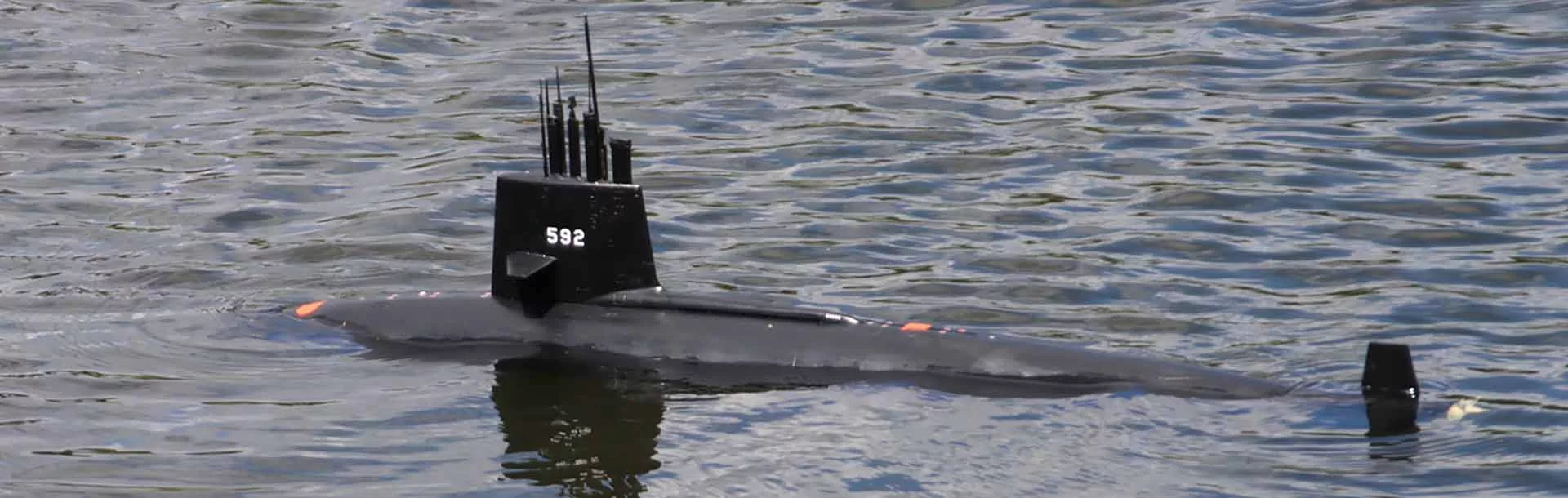
At just over a metre in length the 1:72 Skipjack is a good start into RC submarines. The plastic kit from Revell has the hull in 4 sections, so gluing the 2 top sections together, then the 2 bottom sections to each other allows the hull to split along the centre for access to the WTC. The WTC (also known sometimes as the sub driver) also came as a kit from a UK company (not sure if they’re still in business) so a few modifications are needed to control the rudder, dive planes at rear and propellor.
The WTC came with a drive motor, pump motor and 2 mini servos (for rudder + dive planes) already installed. Once you understand the workings, you could build your own if you have access to a lathe and/or 3D printer. The cylinder has ends caps, with ‘O’ ring seals to keep the water out, as the rest of the hull fills with water. The ballast tank is located centrally to maintain balance fore/aft during static diving operations. Best way to ballast a sub is with weights on the bottom of the hull inside, and foam if necessary at the top of the hull inside – you want the sub to stay level when surfaced and submerged. The Skipjack is ballasted so when in submerged mode, the top of the sail (conning tower in olde speak) is still visible. Reason for this is in case of RC failure the sub should surface to be recovered.
This page is a work in progress… more to come